
The Schut Family
In the early 1900s, on a quiet rural farm in Minnesota, ten-year-old Henry Schut watched with growing concern as his father struggled with daily chores. Once strong and capable, his father's health declined rapidly, leaving him severely weakened. In 1924, at just 46 years old, Henry’s father passed away. The tragedy didn’t end there. Soon after, three of Henry’s uncles also died under similar circumstances. Years later, the disease surfaced again in the family. Henry’s cousin, Bert, began showing symptoms at the young age of 20. He experienced a progressive loss of motor control and difficulty with balance. Seeking answers, Bert went to the University Hospital in Minneapolis, where doctors diagnosed him with ataxia, a neurological condition that affects coordination and movement. Though ataxia can stem from various causes, such as brain injuries or chronic alcohol use, the pattern emerging in Henry’s family pointed to something different. It didn’t align with Friedreich’s ataxia, a more commonly known inherited form. Determined to uncover the truth, Henry began documenting his family's medical history. He created a detailed family tree, carefully noting which relatives were affected and which were not. His records revealed a clear pattern: the condition followed a dominant inheritance pattern, with approximately 50% of the children in each generation affected. Tragically, Bert succumbed to the disease at the age of 30. After his death, his brain was sent to the University of Minnesota for further study, in hopes that understanding the illness might one day lead to a cure, or at least offer answers for future generations.
11/19/20251 min read
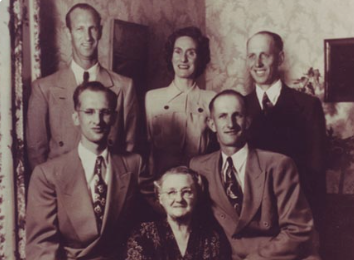
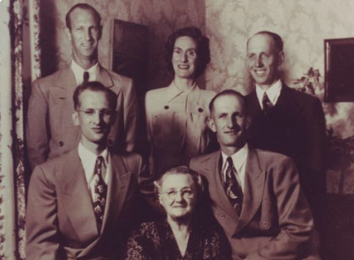
Bert J (top left), Elsie (top middle), Henry (top right), John (middle left), William (middle right), mother (bottom row).
(Nissa Mollema, Harry Orr, American Scientist)
Citations:
Mollema, N. J., & Orr, H. T. (2013, November–December). One family’s search to explain a fatal neurological disorder. American Scientist, 101(6), 442. https://www.americanscientist.org/article/one-familys-search-to-explain-a-fatal-neurological-disorder/
Awareness
Join us in supporting SCA1 research and stories.
Hope for SCA1, inc. is an Illinois nonprofit corporation dedicated to education and awareness.
EIN: 39-3443248
contact: sblake@hopeforsca1.org
The following research initiatives are led independently by academic institutions. Hope for SCA1 is not affiliated with, does not receive funds from, and does not manage donations to these programs.
© 2026. All rights reserved.